

Growing a retail business is exciting, but your systems have to keep pace. Whether you’re opening a second store, onboarding more staff, or handling higher transaction volumes, your IT infrastructure either supports that growth or quietly holds it back. Retail technology is no longer a back-office concern; it’s the backbone of every customer interaction, stock decision, and business report your team relies on.
According to IBM’s Cost of a Data Breach Report 2024, the global average cost of a data breach reached USD $4.88 million, a figure that puts investment in reliable IT in sharp perspective.
Key Takeaways
- IT infrastructure includes your POS systems, networking, cybersecurity, and stock management, all working together
- Outdated retail technology increases downtime risk, staff frustration, and missed sales
- Multi-site retailers need centralised, connected systems to maintain real-time visibility and control
- Managed IT support reduces the burden on business owners and keeps systems running without internal tech staff
- GPK Group has supported 200+ Australian independent retailers with end-to-end IT solutions for over 30 years
Source: IBM Cost of a Data Breach Report 2024, global average USD $4.88M
What retail technology infrastructure actually means?
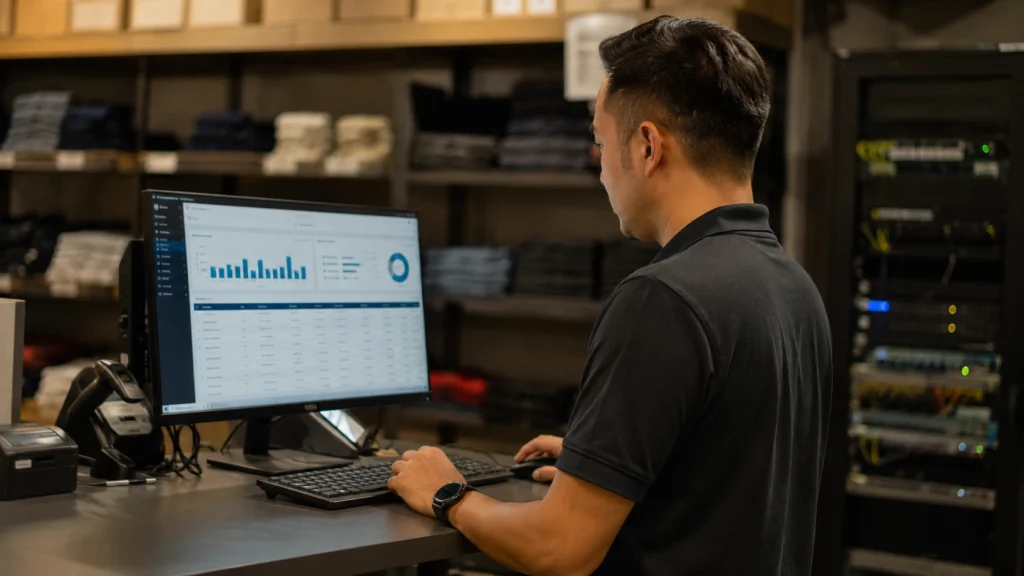
Most retailers think of IT as their internet connection and checkout software. It’s more than that. Your retail technology infrastructure covers everything that keeps your store connected and operational: point of sale systems, inventory management, networking and WiFi, cybersecurity controls, payment processing, CCTV, communications, and the hardware that ties it all together.
When one piece fails, the ripple effect hits fast. A WiFi outage means staff can’t process card payments. An outdated POS system slows checkouts during your busiest period. A server crash leaves you making stock decisions without data.
For independent retailers, this is the reality: you’re operating on the same retail technology as the big chains, but often without a dedicated IT team to manage it. That gap widens the moment you start scaling.
| Infrastructure component | What it does for your store |
|---|---|
| Point of Sale (POS) system | Processes transactions, captures sales data, connects to inventory |
| Networking and WiFi | Keeps all devices connected and trading without interruption |
| Inventory management | Tracks stock in real time, prevents overselling, automates reordering |
| Cybersecurity | Protects customer data, payment records, and business systems |
| Managed IT support | Monitors and maintains all systems proactively, without in-house tech staff |
The real cost of outdated retail systems
Poor retail technology doesn’t just cause frustration; it costs money. Every minute of unexpected downtime during peak trading has a direct impact on revenue, and the cost compounds quickly. For a busy independent supermarket on a Saturday, even a short outage can wipe out a meaningful portion of the day’s takings and erode the customer trust that keeps shoppers coming back.
Outdated systems create security vulnerabilities, too. They generate inaccurate stock data. They slow down your team and chip away at the customer experience that keeps people returning.
There’s also the compliance piece. Retailers handling card payments must meet PCI DSS requirements. Older systems often can’t meet those standards without significant patching, and the liability for a breach sits with the business owner.
IBM’s 2024 research put the global average cost of a data breach at USD $4.88 million. That’s not a figure most independent retailers can absorb.
Retailers who’ve delayed IT upgrades often find themselves stuck: the ongoing cost of doing nothing slowly overtakes the cost of acting. Investing in solid retail technology infrastructure early isn’t a luxury. It’s risk management.
“Independent retailers who delay IT investment often find the ongoing cost of doing nothing exceeds the cost of upgrading. Downtime, data breaches, and disconnected systems all carry a price, and that price grows as your business does.”
Scaling a retail business without the right IT foundation
Opening a second or third location reveals every gap in your current setup. You can’t simply duplicate what worked at store one.
What you actually need is a connected infrastructure that gives you real-time visibility across all sites from a single dashboard.
Common problems retailers run into when scaling without solid IT:
- Stock discrepancies between sites due to disconnected systems
- Inconsistent pricing because updates must be applied manually to each location
- No centralised reporting, so the head office is always chasing data from individual stores
- Security gaps exist because each site runs its own unmanaged systems
Multi-site retail management requires software that handles supplier rebates, consolidated accounts, and cross-site inventory from one platform. That’s not a bonus feature; it’s the minimum requirement for scaling without chaos.
For GPK Group clients such as Morgan’s IGA, which has relied on GPK’s systems for over 15 years, centralised control makes managing multiple locations practical rather than overwhelming.
How managed IT support keeps retail businesses growing
Growing retailers often hit a specific wall: they need IT support, but they don’t need, or can’t justify, a full-time IT employee. That’s where managed IT support changes the equation.
A managed IT provider monitors your systems around the clock, handles software updates, troubleshoots issues before they become outages, and keeps your cybersecurity current. For a retailer focused on the shop floor, that’s one less thing pulling attention away from running the business.
GPK Group provides managed IT services backed by an Australian helpdesk, with no offshore call centres. When something goes wrong, you speak to someone who understands retail and knows your systems.
Retailers who’ve moved to a managed IT model consistently report fewer unexpected outages, faster resolution times, and more confidence when making growth decisions.
When your systems are actively managed, you can open a new site knowing the IT side is already handled. Explore managed IT support for small businesses or review the top 5 managed IT services every retailer needs to get started.
Frequently asked questions
IT infrastructure in retail covers your POS system, inventory and accounting software, networking and WiFi, payment processing, cybersecurity tools, CCTV systems, and the devices and servers that run them. It’s everything that keeps your store connected, transacting, and secure.
Common signs include slow checkout speeds, frequent system crashes, stock discrepancies between sites, difficulty generating accurate reports, and compliance warnings from your payment provider. If any of these are regular occurrences, your infrastructure needs a proper review.
So we provide managed IT retail support that takes care of your entire IT suite for you. From optimising your network to sourcing and rolling out your hardware, and with proactive IT support, we manage it all for you. You focus on running your store, and we take care of the tech.
Not necessarily. Managed IT support gives you access to a dedicated team without the overhead of a permanent hire. For most independent retailers, a reliable managed IT partner covers everything a full-time employee would, at a fraction of the cost.
Without looking at your equipment first, we can’t say for certain whether or not this is possible. So it’s best that we conduct an IT assessment first, to review your current IT systems and determine the best approach.
Our goal is to help you optimise your store’s IT. So we won’t make you upgrade to any tools and technology that you don’t need. It’s all about ensuring you get more efficient and effective retail IT.
GPK Group provides end-to-end IT solutions for Australian independent retailers, including retail IT solutions, Merlin POS software, managed IT support, networking, CCTV, and store fitouts. With 30+ years of experience and 200+ clients, GPK understands the specific demands of retail IT at scale.
Ready to build an IT infrastructure that scales with you?
Your retail business has worked hard to get here. Don’t let outdated technology slow down the next chapter. GPK Group has helped independent Australian retailers scale confidently for over 30 years.
Get in touch with GPK Group to book a free, no-obligation strategy call and find out what your IT infrastructure needs to support your next stage of growth.